
Xpose DTU lectures
The XPOSE Doctoral Training Unit dedicated to Exposome and Health, has a pleasure to welcome three international speakers who will give lectures in the broad domain of exposome.
SPEAKERS:
09.02.2026 – 🇬🇧 Everything, Everywhere, All at once: The Omnipresent Exposome’s Role in Shaping Health
🕒 14:15–15:15 (CET)
On site & online

Vermeulen
Professor of Environmental Epidemiology and Exposome Science at the Utrecht University and University Medical Center Utrecht (UMCU), Scientific Director of the Institute for Preventive Health (i4PH)
Abstract
Understanding the missing environmental component of health and disease is essential for developing effective prevention strategies. While traditional environmental health research has produced important insights into specific hazards, the current paradigm is too narrow and too slow to safeguard populations against rapidly changing environments and societal transitions. The exposome provides a complementary, discovery-oriented perspective — effectively capturing the “everything, everywhere, all at once” nature of environmental influences on biology. It does so by recognising that exposures rarely occur one-by-one, that mixtures may create unanticipated effects,
Recent advances in exposomics, including high-resolution mass spectrometry, geospatial analytics, environmental sensors, image-based inference, and integrated molecular signatures, are now identifying previously unknown risk factors, exposure mixtures, and mechanistic fingerprints relevant to chronic disease. These insights increasingly inform refined risk prediction models and early-detection strategies, positioning the exposome as a critical complement to genomics.
The next frontier is translation: how to turn exposome discoveries into actionable tools for chemical safety assessment, precision public health, urban planning, and health promotion. This talk highlights current scientific progress, examples from European research programmes such as EXPANSE, and practical pathways to operationalise exposome-informed disease prevention and population health strategies.
Information
Lecture:
Parc Hotel Alvisse
120 Rte d’Echternach, 1453 Dommeldange Luxembourg
Room: Hollenfels
Registration:
Registration is mandatory for both online and in-person participation. In person participation will be possible only for the lectures scheduled on 09.02.2025.
Deadline for registration: 04.02.2025

SUPPORTED BY:

09.02.2026- 🇬🇧 Air pollution and the brain – same old, same old?
🕒 15:15–16:15 (CET)
On site & online

Russ
Reader in Old Age Psychiatry in the Centre for Clinical Brain Sciences & Director of the Alzheimer Scotland Dementia Research Centre at the University of Edinburgh
Abstract
In this talk I will outline why dementia is important and why we should investigate air pollution. I will consider the approach taken in many studies of air pollution and brain health and the fact that many studies repeat the same limited methods. I will propose the innovations we would need to learn more about air pollution and the brain and will also touch on translation and impact aspects.
10.02.2026 – 🇬🇧 From Measurement to Prevention: Exploring the Exposome through Cohort Studies
🕒 09:00 –10:00 (CET)
Online only

Mancini
Leader of the Nutrition and Dietary Exposures research group at the Centre for Epidemiology and Population Health of theFrench National Institute of Health and Medical Research INSERM
Abstract
In 2005, Wild stated that although genetics significantly contributes to the development of non-communicable diseases, environmental exposures also play a crucial role. In fact, environmental (non-genetic) factors are responsible for 90% of non-communicable diseases. Therefore, to fully understand the etiology of non-communicable diseases, it is essential to consider both genetic and environmental components. From these observations, the concept of the exposome was developed—defined as the totality of all environmental factors to which an organism is exposed from conception to death and which influence its health status. Studying the exposome is an ambitious goal of the international scientific community and has led to the development of several specific approaches. Each of these approaches has its own strengths and limitations, which must be considered when interpreting results.
This seminar will discuss the concept of the exposome as applied to epidemiology. In particular, the large-scale multigenerational cohort E3N-Générations will be presented as a tool for studying the exposome. Finally, the main exposome-related studies conducted within the cohort will be reviewed, highlighting the strengths and limitations of the different approaches used.
Discover more about Xpose DTU:
XPOSE is an inter-institutional doctoral training programme (PRIDE23/18356118) in Luxembourg coordinated by the Luxembourg Institute of Health (LIH). It is financially supported by the Luxembourg National Research Fund (FNR) co-financed via intramural funds from the LIH, UL and LISER.
DATA PRIVACY
Read more about the “Data Protection Notice: processing of personal data in the scope of events’ management”.
Forthcoming events
-

🇬🇧 Mechanisms of host-microbiota interactions in extraintestinal autoimmunity
Pathogenesis in the age of the microbiome
Speaker: Prof. Dr. Martin Kriegel
26/03/2026 10:30
-

🇬🇧 Living in tissues: Innate lymphoid cells and adaptation of tissue function
Pathogenesis in the age of the microbiome
Speaker: Prof. Dr. Andreas Diefenbach
23/04/2026 13:30
-

🇬🇧 Bacterial aggregation and its possible role in host-microbiome interactions
Pathogenesis in the age of the microbiome
Speaker: Prof. Rosalind Allen
28/05/2026 09:30
-

🇬🇧 EIMN 2026 – 2nd European Immunometabolism conference -Decoding the Interplay Between Metabolism and Immunity
Speaker: Various
10/06/2026 11:00
-
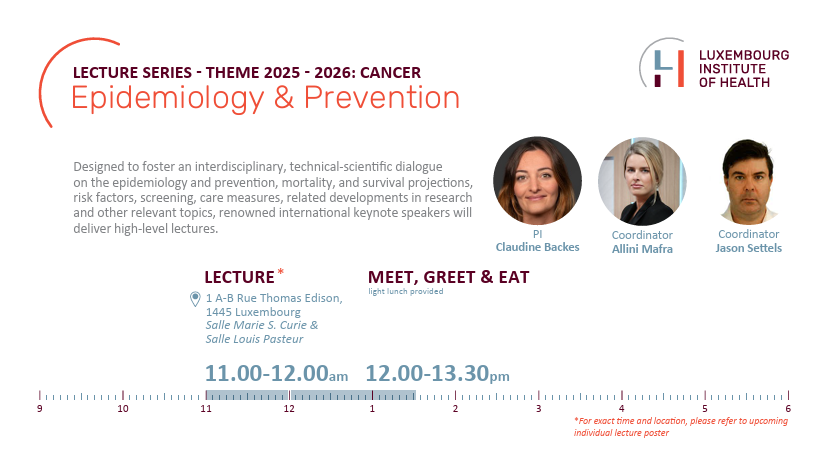
Lecture series – Epidemiology & Prevention 2025-2026
Epidemiology & Prevention
18/06/2026 10:00