News
Six LIH cancer research projects secure over €1 million in Télévie funding
New and renewed grants support innovative research into leukaemia, lung cancer and glioblastoma across three LIH research groups
- Department of Cancer Research
- Cancer
- Tumor Stroma Interactions
- Cancer Metabolism Group
- NORLUX Neuro-Oncology Laboratory
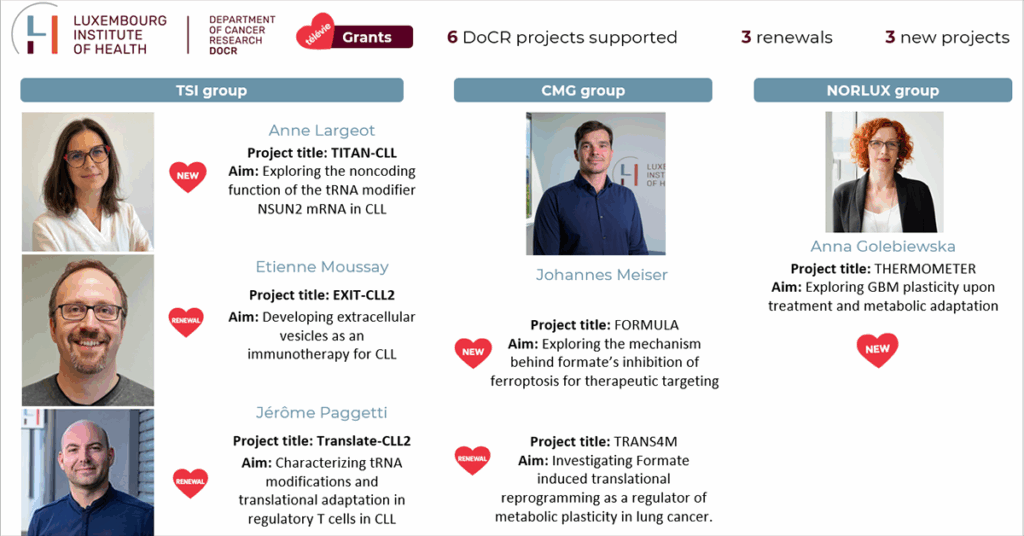
Six research projects from the LIH Department of Cancer Research (DoCR) have been selected for funding through the 2026 Télévie call, securing a combined total of more than EUR 1 million. The three newly funded projects and three grant renewals will support research spanning cancer metabolism, tumour-immune cell interactions and therapy resistance across different cancer types.
The successful projects involve three research groups within the DoCR, namely the Tumour Stroma Interactions (TSI) group, the Cancer Metabolism Group (CMG) and the NORLUX Neuro-Oncology Laboratory, reflecting the diversity of approaches being pursued at LIH to better understand cancer biology and identify new therapeutic opportunities.
Three projects will receive Télévie support for the first time.
Led by Dr Anne Largeot, Senior Scientist in the TSI group, the TITAN-CLL project (“A non-coding oncogenic Function of Nsun2 mRNA in Chronic Lymphocytic Leukemia”) will explore the largely uncharted aspect of transfer RNA (tRNA) modifications in chronic lymphocytic leukaemia (CLL). Building on previous findings showing that CLL cells are highly dependent on altered protein synthesis, the team investigated the enzyme NSUN2, which preliminary data suggest is increased in CLL cells. Unexpectedly, they showed that the function of NSUN2 in CLL is driven by its mRNA and not by the protein it codes for. By determining how NSUN2 mRNA affects tRNA modification, translation fidelity, tumour growth and interactions with the immune system, the project could reveal new mechanisms involved in CLL development and potentially identify new therapeutic vulnerabilities.
In the Cancer Metabolism Group, Dr Johannes Meiser, Head of the DoCR and leader of CMG, and Dr Flavia Radogna, scientist in the CMG, will lead FORMULA (“Formate-driven lipid remodeling and redox homeostasis in ferroptosis”). The project investigates how formate metabolism influences ferroptosis, a form of regulated cell death driven by lipid damage that has attracted growing interest as a potential vulnerability in cancer. Building on the group’s previous work on formate and lipid metabolism, the researchers will study how formate regulates cellular antioxidant capacity and lipid composition and how these metabolic processes in turn affect cancer cells’ susceptibility to ferroptosis. Ultimately, the project will explore whether targeting formate metabolism could enhance ferroptosis-based therapeutic strategies and help identify metabolic signatures predicting treatment sensitivity.
The third new grant, THERMOMETER (“Targeting Glioblastoma Heterogeneity: Metabolic Mechanisms Enabling Temozolomide Resistance”), is led by Dr Anna Golebiewska, Head of the NORLUX Neuro-Oncology Laboratory. It will investigate how the metabolic adaptability of glioblastoma cells contributes to resistance and persistence following treatment with temozolomide, a standard chemotherapy for the disease. Using patient-derived models, spatial metabolomics and drug screening, the team aims to identify metabolic pathways that enable tumour cells to survive treatment and determine whether these pathways could provide new targets for overcoming therapy resistance.
In addition, three ongoing Télévie-supported projects have been renewed, enabling LIH researchers to further develop promising lines of investigation.
Within the TSI group, Dr Etienne Moussay will continue EXIT-CLL-2 (“Extracellular Vesicles as ImmunoTherapy against CLL”), which investigates the role of small extracellular vesicles in creating an immunosuppressive environment in leukaemia and lymphoma. Previous work by the team demonstrated that these vesicles can inhibit the activity of CD8+ T cells against CLL cells. The renewed project will go a step further by engineering extracellular vesicles with the aim of reversing this immunosuppressive effect and reactivating anti-tumour immune responses, while also investigating their metabolic content.
Also in the TSI group, Dr Jérôme Paggetti will lead the continuation of TRANSLATE-2 (“tRNAs Modifications and Translational Reprogramming in Leukemias-Associated Treg”). The project focuses on regulatory T cells, or Tregs, which can contribute to the suppression of anti-tumour immune responses within the CLL microenvironment. The researchers will investigate how these cells adapt their protein synthesis machinery, including through changes in tRNAs and their modifications, and identify translation-related factors essential to their activity. The ultimate objective is to assess whether interfering with these mechanisms could provide new immunotherapeutic strategies.
Finally, Dr Johannes Meiser and the Cancer Metabolism Group have secured renewed funding for TRANS4M (“Formate-induced translational reprogramming as a regulator of metabolic plasticity in lung cancer”). The project explores the interplay between cancer metabolism and protein synthesis, focusing on how lung cancer cells adapt to changes in formate availability. Preliminary findings indicate that formate supplementation can reduce tumour burden in a preclinical model of lung cancer while altering protein synthesis and cellular stress responses. TRANS4M will combine approaches including metabolomics, proteomics and translational profiling to identify the mechanisms involved, evaluate their clinical relevance and investigate the potential of formate-related strategies to improve anti-tumour treatments, including immunotherapy.
The success of the 2026 Télévie call underscores the excellence of our scientists and the high clinical impact of our cancer research. We are extremely grateful to Télévie for their sustained support, which keeps enabling our research teams to build on promising discoveries over time while pursuing new avenues with great relevance for patients
says Dr Frank Glod, Deputy CEO of LIH.
Scientific Contact
Related News