News
Clinnova Annual Report 2025 highlights evolution towards a European precision health infrastructure

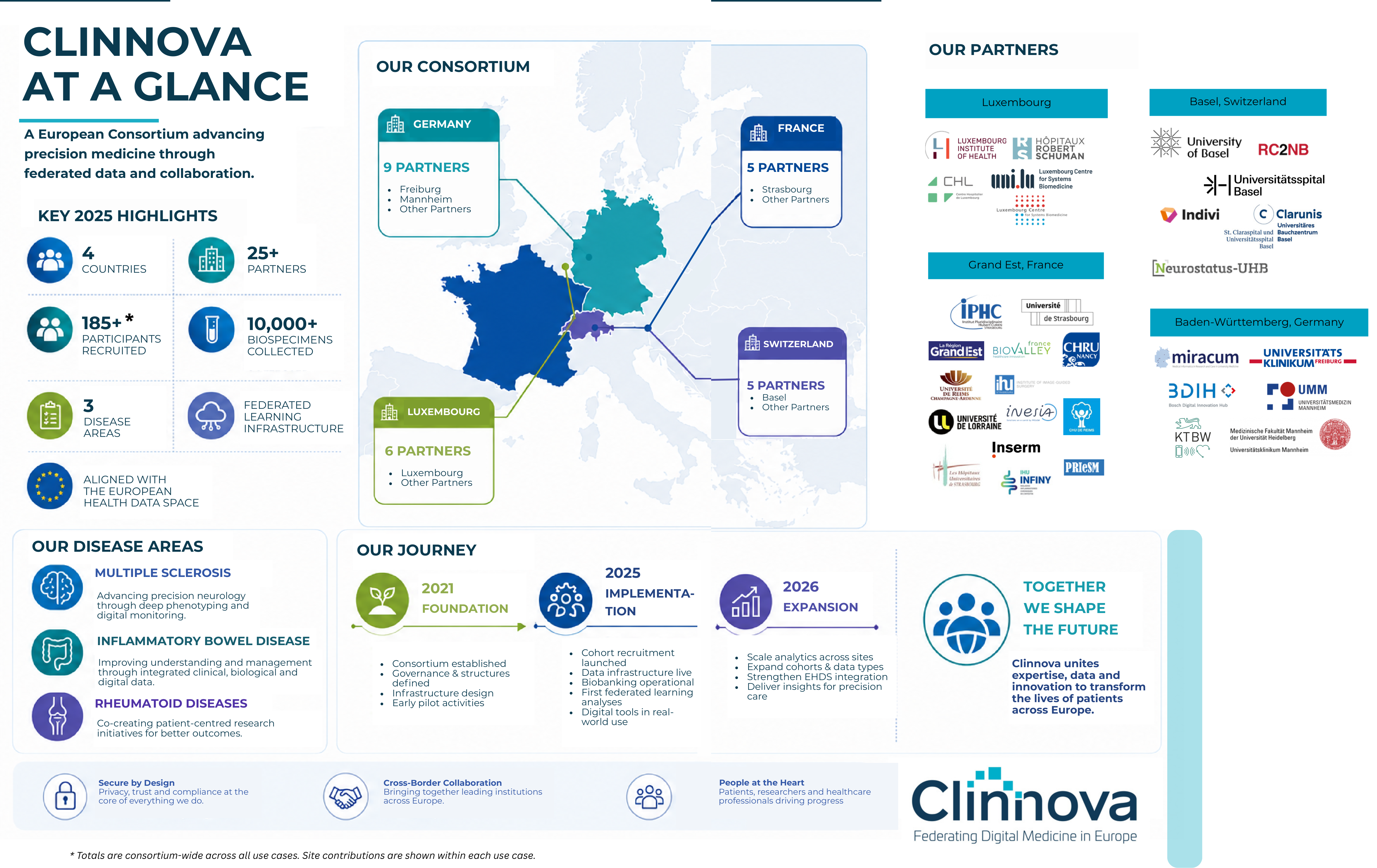
The European Clinnova Consortium has published its 2025 Annual Report, documenting the major progress achieved last year in building cross-border precision health infrastructure. With more than 25 partner institutions spread across Luxembourg, Switzerland, Germany and France, Clinnova is developing the standards and capabilities needed to make health data more interoperable and useful for research. For the Luxembourg Institute of Health (LIH), this past year marked an important step in translating this European ambition into a sustainable national research infrastructure.
From a European initiative to an operational research ecosystem
Clinnova focuses on three immune-related disease areas: inflammatory bowel disease (IBD), multiple sclerosis (MS) and rheumatoid diseases (RD). By the end of 2025, the consortium recruited more than 185 participants and collected over 10,000 biospecimens.
At the heart of the programme is a federated data infrastructure, allowing clinical data to remain within the institution where it was collected while enabling external researchers to query and analyse information across the various sites. This supports cross-border research while maintaining control over sensitive patient data.
The report shows how this infrastructure moved from idea to implementation, supported by common data standards, shared procedures and collaboration between researchers, clinicians, data specialists and patient partners.
The LIH helps build the Luxembourg foundation
The LIH has played a central role in developing Clinnova’s Luxembourg infrastructure. The work of LIH researchers and experts helped establish the IT infrastructure and standard operating procedures required for harmonised data collection across the consortium.
A key achievement was the establishment of a Prototype Data Integration Centre, developed by the LIH in collaboration with the Hôpitaux Robert Schumann (HRS). This collaboration demonstrates how clinical and research data can be securely connected within a real-world hospital environment, while keeping sensitive information under appropriate local governance.
Following the completion of Clinnova’s first phase, its infrastructure and operational processes are now being integrated into the new Luxembourg Research Clinic (Fuerschungsklinik Lëtzebuerg). Its data integration concept and clinical trial toolbox will also contribute to the development of a secure and interoperable data network connecting hospitals across Luxembourg.
Clinnova has allowed us to test and implement new ways of securely connecting clinical data, biospecimens and research expertise across institutions and borders. We will now build on this experience within the Luxembourg Research Clinic to support a broader range of local clinical studies, while at the same time further strengthening our connections with European research networks
said Dr Jasmin Schulz, coordinator of Clinnova at the LIH.
Read and download the Clinnova European Consortium Annual Report 2025!
Funding and collaborations
Clinnova’s Luxembourg programme is supported by the National Centre of Excellence in Research (NCER) program, an initiative of the Luxembourg National Research Fund (FNR).
Scientific Contact
Related News