

TreatPD
An RNA to treat Parkinson’s disease
Summary
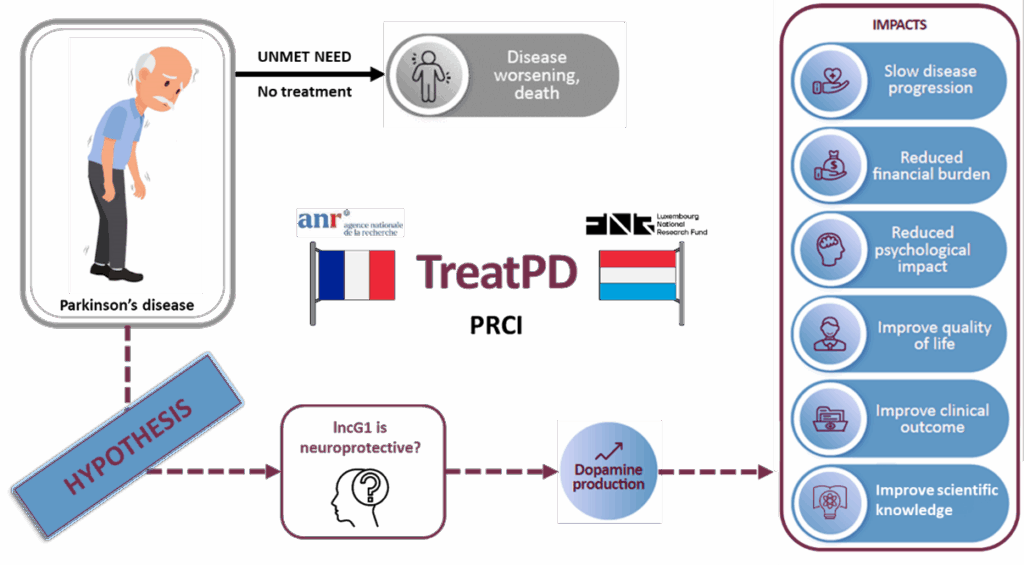
Parkinson’s disease (PD) is an age-related, progressive, neurodegenerative disease that is complex, heterogeneous, and deadly. PD specifically impairs the central nervous system and is characterized by a loss of dopamine production in the brain. Due to population ageing, the prevalence of PD is increasing and is associated with a high socio-economic burden. Actual therapy for PD targeting the restoration of dopamine levels can effectively relieve symptoms, it does not treat the disease’s root cause and cannot prevent its progression. Therefore, PD is still considered irreversible and incurable and there is an unmet clinical need for disease-modifying therapies.
TreatPD is based on an RNA molecule arbitrarily named lncG1 that is dysregulated in PD patients. Preliminary experiments show that lncG1 over-expression in cultured neurons stimulates the dopamine synthesis pathway and increases dopamine production. Based on these supporting data, lncG1 may be used as a PD-modifying therapy.
The purpose of TreatPD is to develop a novel nanoparticle carrier of lncG1 that can cross the blood-brain barrier and target dopaminergic neurons in the brain.
The project is based on complementary expertise from four partners, three in France (in RNA production, nanoparticles and animal models of PD) and one in Luxembourg (in RNA and which identified lncG1).
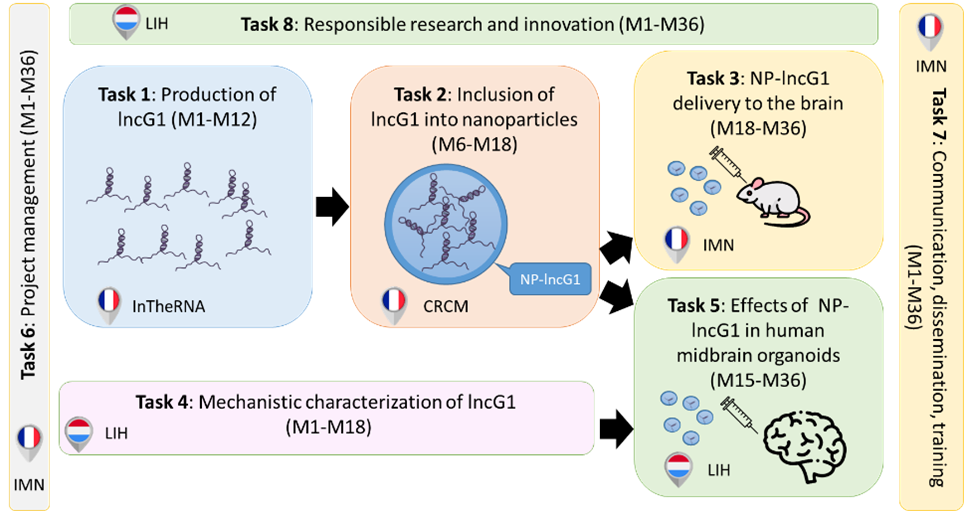
As described in the different work packages, synthetic lncG1 will be produced and embedded in nucleolipid nanoparticles to ensure it can cross the blood-brain barrier and release into dopaminergic neurons. This carrier, NP-lncG1, will be tested in two murine models of PD to check its capacity to cross the blood-brain barrier in vivo and to evaluate its effect on dopaminergic neurons. In parallel, in silico and in vitro investigations will be performed to fully characterize the molecular mechanism of action of lncG1, validate its capacity to stimulate the dopamine synthesis pathway, and identify potential side effects. Through a partnership, the effects of NP-lncG1 will be evaluated in human brain organoids, including dopaminergic neuron survival, dopamine production and other pathways identified during this project. Overall, the plan beyond the TreatPD project is designed to develop and extensively validate NP-lncG1, a nanoparticle carrier of neuroprotective lncG1.
CONTACT
The impacts of this project are as follows:
- Societal impact: reduce psychological stress by bringing hope to PD patients, their families and caregivers reducing symptoms and improving quality of life and life expectancy.
- Economic impact: reduction of healthcare costs through a modification of disease trajectory.
- Scientific impact: increased knowledge of the role of RNA molecules in PD development.
To ensure these impacts are reached and end-users accept the solution provided by this project, the main stakeholders (neurologists, patients) are involved in the project from an early stage. They will greatly participate in the dissemination and adoption of project results.
Work plan
Partners

France

Institut des maladies neurodégénératives de Bordeaux (IMN)
Benjamin Dehay, Marie-Laure Arotcarena, Marie-Laure Thiolat



Funding