
Bitte beachten Sie, dass der Inhalt nur auf Englisch verfügbar ist.
LECTURE SERIES – THEME 2025/2026: CAUSAL INFERENCE METHODS FOR REAL-WORLD DATA
Causal inference methods for real-world data
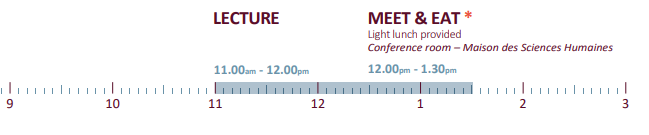
*For exact time and location, please refer to upcoming individual lecture poster
PAST EVENTS:
09.07.2026 – 🇬🇧 Assessing the short-term effects of air pollution on health: a causal inference perspective
Michela Baccini
Full Professor of Medical Statistics, University of Florence
This seminar will focus on the short-term effects of air pollution on human health. After a brief introduction to traditional regression-based methods for assessing exposure–response associations, I will formalize the problem within the potential outcomes framework for causal inference. I will then present examples illustrating how this approach can be used to estimate causal dose–response relationships and to perform health impact assessments by quantifying the number of attributable deaths under alternative exposure scenarios.
01.07.2026 – 🇬🇧 Scalable Causal Discovery for Statistically Efficient Causal Inference
Sara Magliacane
Professor of Machine Learning at Saarland University
Causal discovery methods can identify valid adjustment sets for causal effect estimation for a small set of target variables, even when the underlying causal graph is unknown. Global causal discovery methods focus on learning the whole causal graph and therefore enable the recovery of optimal adjustment sets, i.e., sets with the lowest asymptotic variance, but they quickly become computationally prohibitive as the number of variables grows. Local causal discovery methods offer a more scalable alternative by focusing on the local neighbourhood of the target variables, but they are restricted to statistically suboptimal adjustment sets.
In this talk, I will present two recent methods that combine the computational efficiency of local methods with the statistical optimality of global causal discovery methods. First, I will describe the Sequential Non-Ancestor Pruning (SNAP) framework (https://arxiv.org/abs/2502.07857). SNAP progressively identifies and prunes definite non-ancestors of the target variables during the causal discovery process. We show that the resulting subgraph is sufficient for identifying the causal relations between the targets and their efficient adjustment sets. Then, I will introduce Local Optimal Adjustments Discovery (LOAD) (https://arxiv.org/abs/2502.07857), a method for identifying optimal adjustment sets from local information. As a first step, LOAD identifies the causal relation between the targets and tests if the causal effect is identifiable by using only local information. If it is identifiable, it then finds the possible descendants of the treatment and infers the optimal adjustment set as the parents of the outcome in a modified forbidden projection. Otherwise, it returns the locally valid parent adjustment sets based on the learned local structure. For both methods, I will show that on our evaluation they outperform global methods in scalability, while providing more accurate effect estimation than local methods.
07.05.26 – 🇬🇧 Do causal inference practices uniquely predicts causal inference quality?
Julia Roher
Academic assistant (lecturer) at Leipzig University
Abstract
Correlation does not imply causation, but teaching applied researchers pretty much just that – and nothing else – about causal inference has had some peculiar consequences. For example, researchers have come up with very creative phrasings to imply causality while maintaining some degree of plausible deniability (such as the language of „unique“ prediction), or have put undue faith in pseudo-solutions. In this webinar, I will share some observations that are mainly drawn from psychology but echo concerns raised in other fields (including other social and life sciences). I will discuss a major tension in the debate about causality: if researchers are taught how causal inference works in principle, will they end up drawing even more bad causal inferences? And I will also propose potential ways to make rigorous causal inference more mainstream.
Further viewing
While a recording of this lecture is not available, we invite you to discover this related talk by Julia Rohrer, which addresses a similar topic.
29.04.26 – 🇬🇧 Causal inference and AI
Martin Huber
Professor of Applied Econometrics and Policy Evaluation – Department of Economics of Fribourg University
Abstract
This lecture provides an introduction to causal machine learning methods for estimating treatment effects in observational and experimental studies with high-dimensional covariates. The focus is on modern approaches that combine the flexibility of machine learning with causal inference in order to estimate treatment effects conditional on covariates and uncover effect heterogeneity across subgroups in a data-driven manner. The lecture discusses the challenges of treatment or impact evaluation when the set of potential confounders is large and conventional parametric models may be too restrictive. It also introduces two prominent approaches that allow researchers to control for covariates in a data-adaptive way and estimate heterogeneous treatment effects: causal (random) forests and the double machine learning framework, the latter of which can be combined with a wide range of machine learning methods. Applications from the health sciences/economics illustrate how these methods can be used to estimate both average and subgroup-specific causal effects and to detect effect heterogeneity. The lecture also demonstrates how these methods can be implemented in R, making the session useful for applied researchers interested in integrating causal machine learning into their empirical work.
19.03.26 – 🇬🇧 Applications of causal inference in public policy
Fabrizia Mealli
Professor of Econometrics at the European University Institute’s Department of Economics
Abstract
We introduce methods for studying for causal effects in settings characterized by interference, arising when the outcome of a unit (e.g., patient’s infection) depends not only on their own treatment (e.g., vaccination) but also on the treatment of others (e.g., friends).
We first introduce estimands and explore identification and estimation strategies in experimental and observational settings. We then focus on important but nonstandard settings having two distinct sets of units:
units to which the intervention is applied and units on which the outcomes are measured, which is called bipartite interference: treatments applied to one intervention unit can affect multiple outcome units, and the outcome of a unit may depend on the treatments applied to multiple intervention units. We illustrate the methods with some case studies.
05.02.26 – 🇬🇧 Policy relevant effects in infectious disease studies
Mats Stensrud
Associate professor
Chair of Biostatistics, École Polytechnique Fédérale de Lausanne
🇬🇧 Policy relevant effects in infectious disease studies
When facing infectious diseases, healthcare professionals must make decisions under uncertainty. Certain considerations are frequently recurring in this process. Knowing whether a vaccine’s effect wanes is important for determining the timing of seasonal flu shots or assigning COVID-19 boosters. Understanding whether a vaccine has heterogeneous effects on different subtypes, such as Malaria variants, has implications for the development of new treatments. Whether vaccinating a subgroup of individuals is sufficient to reach herd immunity, due to spill-over effects, shapes public health policies. Although the previous plain English sentences might seem clear, I will argue that terms like “waning”, “heterogeneous effects”, and “spill-over” are ambiguously interpreted. I will then propose ways to clarify these terms based on theory and methods for causal inference. Using Malaria, HIV, influenza, and COVID-19 as illustrative examples, I will show that these clarifications matter in practice. In particular, I will leverage the clarifications to define new treatment effects in vaccine settings, which sometimes justify existing analytic approaches and also motivate new methods that are feasible to implement.
18.12.25 – 🇬🇧 „Causal AI”: Is causal inference from healthcare data about to be automated?
Miguel Hernán
Director of CAUSALab
Professor of Epidemiology and Biostatistics at Harvard
🇬🇧 „Causal AI”: Is causal inference from healthcare data about to be automated?
Decisions about the treatment and prevention of disease are guided by causal inference and health researchers often make causal inferences using healthcare databases. The emergence of tools referred to as “AI” may transform the way in which those databases are used for causal inference. However, for “AI” to speed up the causal learning for healthcare databases, we need a better understanding of what both “AI” and causal inference are. This talk dissects the components of “Causal AI” and
discusses its potential to automate causal research in the health sciences.
14.11.2025 – 🇬🇧 Causal inference with compositional data
Georgia Tomova
Research Fellow at the UCL Centre for Longitudinal Studies Co-leader of the Causal Inference Interest Group
🇬🇧 Causal inference with compositional data
Compositional data is a form of hierarchical data in which a whole (or a total) is the sum of its constituent components. Although compositional data can arise in any setting, they are particularly common in health research, with typical examples including dietary, physical activity, or microbiome data. This type of data can bring a range of analytical and interpretational challenges which risks results being misinterpreted.
In this talk, I will introduce compositional data using directed acrylic graphs (DAGs), outline the different types of causal effects that may be of interest in such data, and discuss suitable analytical approaches.
01.10.2025 – 🇬🇧 Introduction to causal inference and directed acyclic graphs
Peter Tennant
Associate Professor of Health Data Science at the University of Leeds Former fellow of the UK’s Alan Turing Institute Incoming George Sadan Visiting Associate Professor at Yale University for 2026
🇬🇧 Causal Inference Methods for Real-world data
Estimating causal effects in non-experimental data is a key aim of applied health and social science research. Unfortunately, it is also notoriously difficult.
Contemporary causal inference methods, including directed acyclic graphs, promise to revolutionise the analysis and interpretation
non-experimental data, not least by making our ambitions and assumptions far more explicit. In the health sciences, these methods are rapidly gaining popularity, but they are still yet to be adopted as widely as other entrenched
methods.
This talk offers a simple introduction to the new
science of causal inference, with a particular focus on directed acyclic graphs.
Contact
Information
Lecture:
11 porte des Sciences
L-4366 Esch-sur-Alzette, Luxembourg
Maison des Sciences Humaines – Conference room
*For exact time and location, please refer to upcoming individual lecture poster
Annual poster
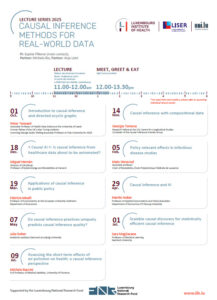
Supported by: