
Press Release
Predicting disease through voice recordings and AI: experts establish standards for vocal biomarkers
New international research establishes framework for vocal biomarkers in voice-based disease detection

A person’s voice can express far more than just what they are saying. Researchers are increasingly discovering that subtle changes in speech, breathing and vocal quality provide valuable clues about a wide range of health conditions, from Parkinson’s and Alzheimer’s to depression, heart failure and type 2 diabetes. These voice-derived indicators, known as vocal biomarkers, are expected to soon be used for disease diagnosis and monitoring.
To help unlock this potential, researchers and clinicians from the Department of Precision Health (DoPH) at the Luxembourg Institute of Health (LIH) and the University of South Florida (USF) Morsani College of Medicine have led a new international effort to establish the first consensus-based framework and definitions for vocal biomarkers.
Published in the journal Digital Biomarkers as part of the VOCAL (Vocal Biomarker Guidelines for Ontology, Classification, Application and Logistics) initiative, the study brings together 24 international experts from Europe and North America to address a key challenge facing voice-based health technologies: the lack of a common scientific language.
As research on vocal biomarkers becomes more popular, the field’s rapid growth has led to inconsistent terminology, with concepts such as “voice biomarkers”, “speech biomarkers” and “vocal biomarkers” often used interchangeably, despite referring to different physiological and cognitive processes.
To address this challenge, eVoiceNet — a European network coordinated by the Luxembourg Institute of Health, and Bridge2AI-Voice — a North American consortium funded by the NIH and co-led by USF researchers, conducted a rigorous multi-stage consensus process between 2024 and 2025. The result is a structured framework that clearly distinguishes between vocal measures and validated vocal biomarkers and introduces a hierarchical model spanning the different domains involved in voice and speech production.
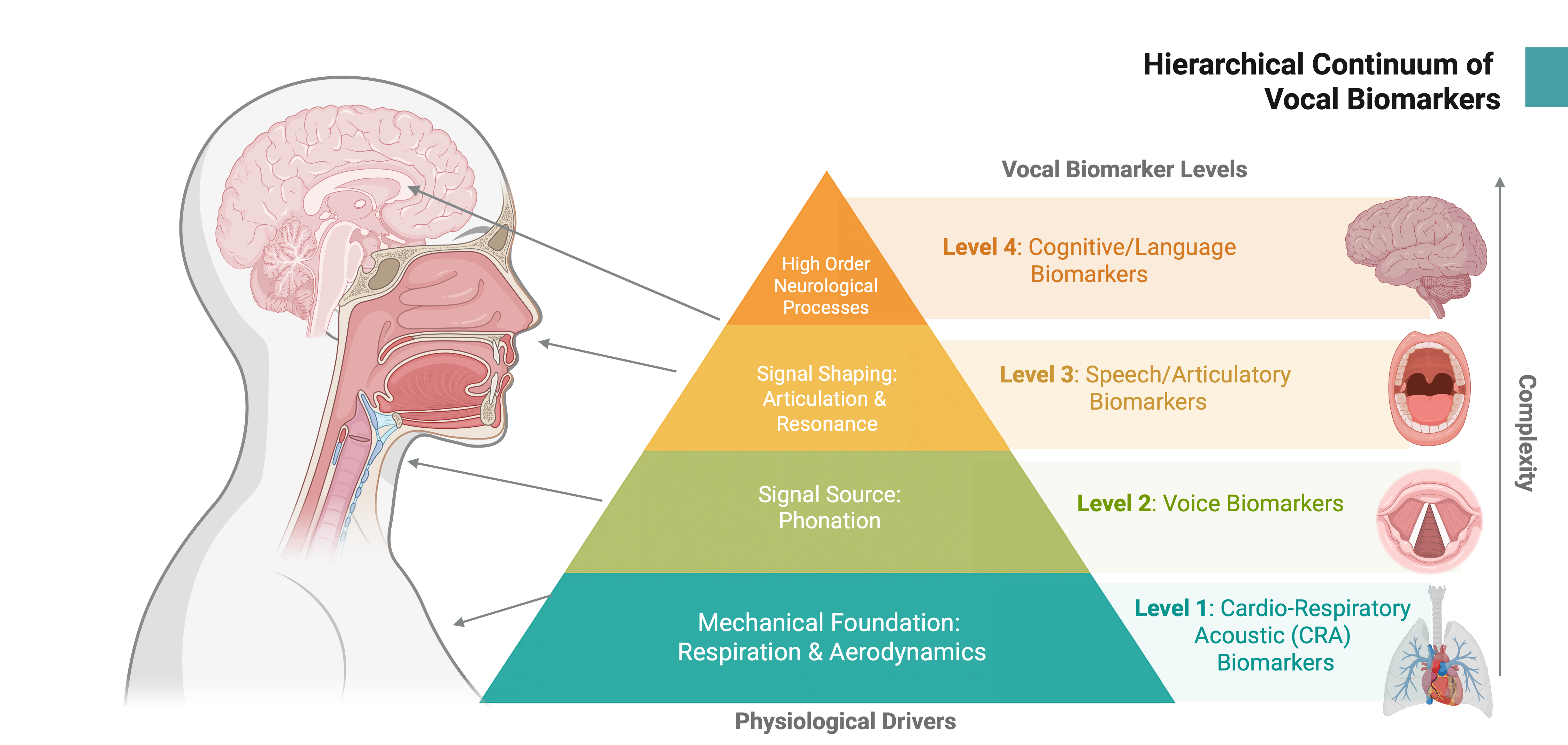
The framework provides a scientifically grounded vocabulary designed to improve collaboration between clinicians, speech and language specialists, engineers, data scientists, regulators, and industry stakeholders. It also aims to support the future development of standards, validation pathways and regulatory guidance for voice-based health technologies.
Voice has enormous potential as a source of health information, but the field cannot progress efficiently without a common language. By defining what we mean when we talk about voice-based health measures, we are creating the foundations for more robust research, greater transparency and, ultimately, clinically useful technologies that can benefit patients,
said Dr Guy Fagherazzi, head of the Department of Precision Health at the LIH and chair of eVoiceNet.
Dr Yael Bensoussan, associate professor of Otolaryngology at the USF Health Morsani College of Medicine and co-head of the Bridge2AI-Voice consortium, said the framework reflects both the promise and complexity of vocal biomarker research.
“One of the unique strengths of vocal biomarkers is that they capture information from multiple physiological and cognitive systems simultaneously,” Bensoussan said. “However, this complexity is also what has made the field difficult to define. This work provides a structure that allows researchers to speak the same scientific language while preserving the richness of the signal.”
The publication marks the first phase of the broader VOCAL initiative, which aims to establish international guidelines and standards for vocal biomarker research and implementation. The researchers hope that a shared vocabulary will help accelerate the translation of voice-based technologies from the lab to the clinic.
About the Luxembourg Institute of Health (LIH)
The Luxembourg Institute of Health (LIH) is a public biomedical research organisation focused on precision health and invested in becoming a leading reference in Europe for the translation of scientific excellence into meaningful benefits for patients.
The LIH places the patient at the heart of all its activities, driven by a collective obligation towards society to use knowledge and technology arising from research on patient derived data to have a direct impact on people’s health. Its dedicated teams of multidisciplinary researchers strive for excellence, generating relevant knowledge linked to immune related diseases and cancer.
The institute embraces collaborations, disruptive technology and process innovation as unique opportunities to improve the application of diagnostics and therapeutics with the long-term goal of preventing disease.
About the University of South Florida (USF)

The University of South Florida is a top-ranked research university serving approximately 50,000 students from across the globe at campuses in Tampa, St. Petersburg, Sarasota-Manatee and USF Health.
In 2025, U.S. News & World Report recognized USF with its highest overall ranking in university history, as a top 50 public university for the seventh consecutive year and as one of the top 15 best values among all public universities in the nation. U.S. News also ranks the USF Health Morsani College of Medicine in the highest tier, placing it as one of the top 16 medical schools in the nation and inside the top 10 among public universities.
USF is a member of the Association of American Universities (AAU), a group that includes only the top 3% of universities in the U.S. With an all-time high of $750 million in research funding in 2025 and as a top 20 public university for producing U.S. patents, USF uses innovation to transform lives and shape a better future. The university generates an annual economic impact of nearly $10 billion for the state of Florida. USF’s Division I athletics teams compete in the American Conference.