
Zoonotic project
Background
Infectious diseases represent important challenges to animal health worldwide. Pathogens can have a huge impact on the health of livestock – threatening every step of the production process -, companion animals and wildlife. Infectious diseases in livestock lead to enormous costs for society in addition to direct production losses borne by farmers, due to food safety assurance, increased prices for consumers, prevention and surveillance campaigns, culling and stamping out policies, trade restrictions, etc.
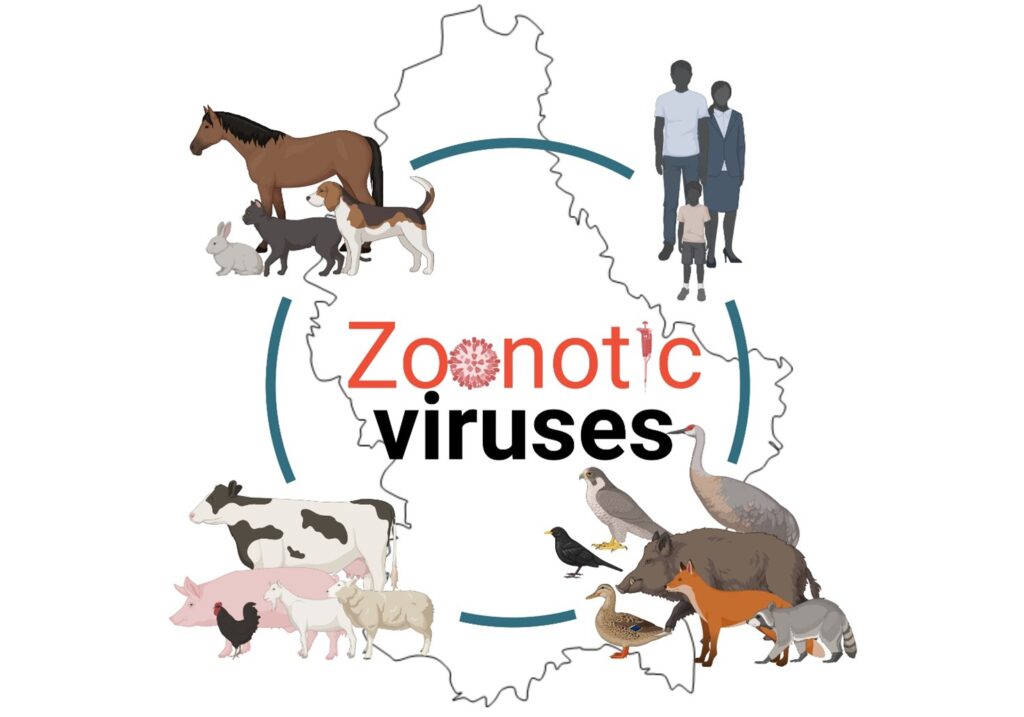
Many pathogens have complex transmission cycles and affect several wild and domestic species, thus drastically complicating their control. Some animal pathogens may also be naturally transmitted to humans, causing so called “zoonotic infections”. Indeed, it is estimated that more than 60% of human pathogens are of animal origin. Surveillance and management of infectious diseases in animals thus have a direct impact on human health.
The recognition of the interactions between the health of our environment, of animals and of human beings resulted in the “One Health” concept, which encourages environment, wildlife, domestic animals and human health professionals to work together to address the world’s most important health challenges, including in the field of zoonotic diseases.
CONTACT
Aims
The main objective of the project “Surveillance and characterization of important livestock and ZOONOTIC VIRUSES in Luxembourg” is to provide critical answers to animal and public health authorities for outbreak prevention and control.
Different aspects of the project include the monitoring and characterization of avian influenza virus and avian paramyxovirus type-1 in domestic and wild birds to support the Luxembourg Veterinary and Food Administration (ALVA) in the national surveillance programs. The project also aims at monitoring and characterizing other important pathogens circulating in domestic and wild animals, depending on ever evolving international contexts. Existing diagnostic tools are continuously updated to maintain their fitness-for-purpose in light of pathogen diversity, evolution and geographic distribution. New tools are frequently established to prepare the country for (re-)emerging infectious diseases of animal origin.
The results generated are shared regularly with national authorities to
- monitor disease occurrence and trends,
- properly estimate and map their circulation in the country,
- identify reservoirs, introduction routes and transmission pathways,
- trigger rapid investigation and outbreak responses,
- guide prevention and control measures,
- serve as early warning system to identify the presence or emergence of zoonotic agents in animal populations, including novel or re-emerging diseases,
- monitor reverse zoonosis events (i.e. transmission of a pathogen from humans to animals),
- provide scientific evidence for risk assessment and national preparedness.
Initially focused on viral pathogens, surveillance programs are being extended to bacterial diseases to provide further support to national authorities. This project is part of a long-standing collaboration of nearly 20 years between the LIH and ALVA.
Partners
This project is part of a long-standing collaboration of nearly 20 years between the LIH and ALVA.

Funding
The project is supported by the Ministry of Agriculture, Food and Viticulture.