
🇬🇧 Policy Relevant Effects in Infectious Disease Studies
- Lecture Series – Causal Inference Methods For Real-World Data
Veuillez noter que le contenu n’est disponible qu’en anglais.
Speakers

Stensrud
Associate Professor, Chair of Biostatistics
École Polytechnique Fédérale de Lausanne
Abstract
When facing infectious diseases, healthcare professionals must make decisions under uncertainty. Certain considerations are frequently recurring in this process. Knowing whether a vaccine’s effect wanes is important for determining the timing of seasonal flu shots or assigning COVID-19 boosters. Understanding whether a vaccine has heterogeneous effects on different subtypes, such as Malaria variants, has implications for the development of new treatments. Whether vaccinating a subgroup of individuals is sufficient to reach herd immunity, due to spill-over effects, shapes public health policies. Although the previous plain English sentences might seem clear, I will argue that terms like “waning”, “heterogeneous effects”, and “spill-over” are ambiguously interpreted. I will then propose ways to clarify these terms based on theory and methods for causal inference. Using Malaria, HIV, influenza, and COVID-19 as illustrative examples, I will show that these clarifications matter in practice. In particular, I will leverage the clarifications to define new treatment effects in vaccine settings, which sometimes justify existing analytic approaches and also motivate new methods that are feasible to implement.
Responsible Scientist
Leist
Faculty of Humanities, Education and Social Sciences
Department of Social Sciences
University of Luxembourg



LOCATION
LECTURE: 11:00am – 12:00pm
Maison des Sciences Humaines
Room: Conference room
11, porte des Sciences
L-4366 Esch-sur-Alzette, Luxembourg
Webinar via Webex:
Event number: 2795 672 8004
Event password: tZ236kyqWke
MEET & EAT
12:00pm – 13:30pm
Conference room – Maison des Sciences Humaines
Light lunch provided – Please note that registration for Meet and Eat is mandatory via the following link:
Supported by:

Protection des données
En savoir plus sur la « Notice sur la protection des données : traitement des données personnelles dans le cadre de la gestion des événements ».
Événements à venir
-

🇬🇧 Living in tissues: Innate lymphoid cells and adaptation of tissue function
Pathogenesis in the age of the microbiome
Orateur : Prof. Dr. Andreas Diefenbach
23/04/2026 13:30
-

🇬🇧 Bacterial aggregation and its possible role in host-microbiome interactions
Pathogenesis in the age of the microbiome
Orateur : Prof. Rosalind Allen
28/05/2026 09:30
-

🇬🇧 EIMN 2026 – 2nd European Immunometabolism conference -Decoding the Interplay Between Metabolism and Immunity
Orateur : Various
10/06/2026 11:00
-
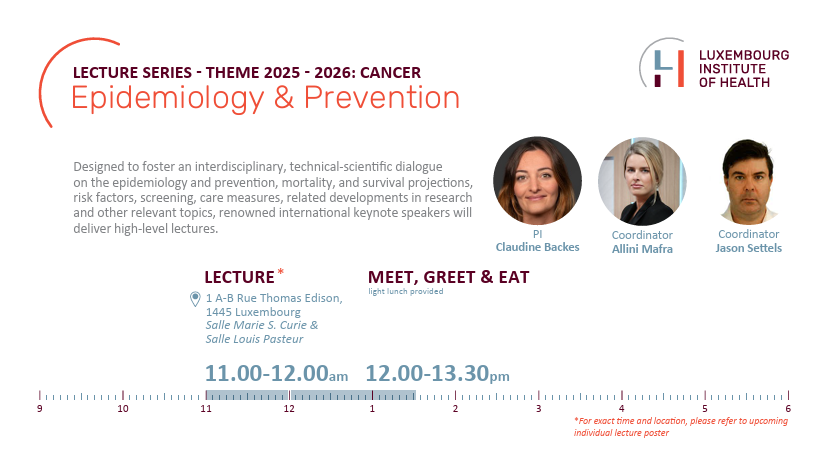
Lecture series – Epidemiology & Prevention 2025-2026
Epidemiology & Prevention
18/06/2026 10:00